
A P11D reports taxable benefits you or your staff get through your company. Here’s what goes on it, when it’s due and what changes from April 2027.

A P11D is the form your company uses to tell HMRC about taxable benefits and expenses given to employees and directors on top of their salary. If anyone had a benefit in kind during the tax year, you file it by 6 July after the tax year ends.
A P11D shows HMRC the value of the benefits each person received, so the right tax can be collected. You complete one for every employee or director who had taxable benefits.
Alongside these, your company files a single P11D(b). This summary adds up all the benefits and works out the Class 1A National Insurance the company owes.
In most small limited companies, the person with the benefits is you, as the director. Whether or not you have employees, your company needs a PAYE scheme to file, even if you only take dividends.
What counts as a benefit in kind?
A benefit in kind is anything of value your company gives you or other employees outside a salary. HMRC treats it as part of the person’s earnings, so it’s taxable.
The benefits in kind we see most often with directors are:
a company car or van, plus fuel for personal use;
private medical or dental insurance;
a director’s loan over £10,000 that’s interest-free or below HMRC’s official rate;
accommodation provided by the company;
personal bills the company pays for you.
Company cars and medical cover are common for employees too. Staff are also more likely to have things like gym memberships, gift cards or vouchers and interest-free loans, such as a season ticket loan over £10,000.
Which benefits are tax-free?
Some benefits are exempt, so they stay off the P11D and there’s no tax or Class 1A to pay. The most common are:
employer pension contributions;
one mobile phone per employee;
business mileage paid at HMRC’s approved rates;
reimbursed business expenses, such as travel to a client meeting;
a bike through a cycle to work scheme;
electric car charging at your workplace;
eye tests for staff who use screens.
There are two other exemptions but both come with conditions:
Trivial benefits are tax-free if each one costs £50 or less, isn’t cash or a cash voucher, and isn’t a reward for work. A bottle of wine on a birthday counts. A gift card for hitting a target doesn’t. Directors of close companies, which usually means companies run by their owners, can receive up to £300 of these a year.
Staff parties are exempt if the total for the year comes to £150 or less per head and the event is open to all your staff. Go £1 over and the whole amount becomes taxable, so keep an eye on it if you hold more than one event.
For directors, employer pension contributions are the most useful exempt benefit of all. The company gets Corporation Tax relief, and you pay no tax or National Insurance on the contribution. Read our guide on how a company pension works to see how it fits with your salary and dividends.
When is the P11D deadline?
The P11D and P11D(b) are due by 6 July after the tax year ends. Each employee needs a copy of their P11D by the same date. Class 1A National Insurance is then due by 22 July if you pay electronically, or 19 July by cheque.
For the 2026/27 tax year, which ends on 5 April 2027, that means:
File all P11Ds and the P11D(b) online by 6 July 2027
Give each employee their copy by 6 July 2027
Pay Class 1A by 22 July 2027
Everything goes in as one online submission, through HMRC’s PAYE Online service or payroll software. HMRC sets out the full dates in its expenses and benefits guidance.
How is tax on benefits paid?
Employees and directors pay income tax on their benefits, and the company pays Class 1A National Insurance on the total value. The Class 1A rate is 15% for 2026/27, so £5,000 of benefits costs the company £750.
If you or your employees are paid through PAYE
The tax is collected through each person’s tax code. HMRC uses the P11D figures to adjust the code, and the tax comes out of their salary over the following year. If you file a Self Assessment return, your benefit values go on there too.
When an employee gets a new benefit, their tax code will change. A quick word with them before it happens saves a confused conversation when their payslip looks different.
If you don’t take a salary
There’s no salary for a tax code to collect from, so you pay the tax on your benefits through your Self Assessment return.
Is the P11D being replaced?
Yes, in stages. HMRC confirmed in June 2026 that benefits will move into payroll in two phases, with tax and Class 1A collected through each pay run.
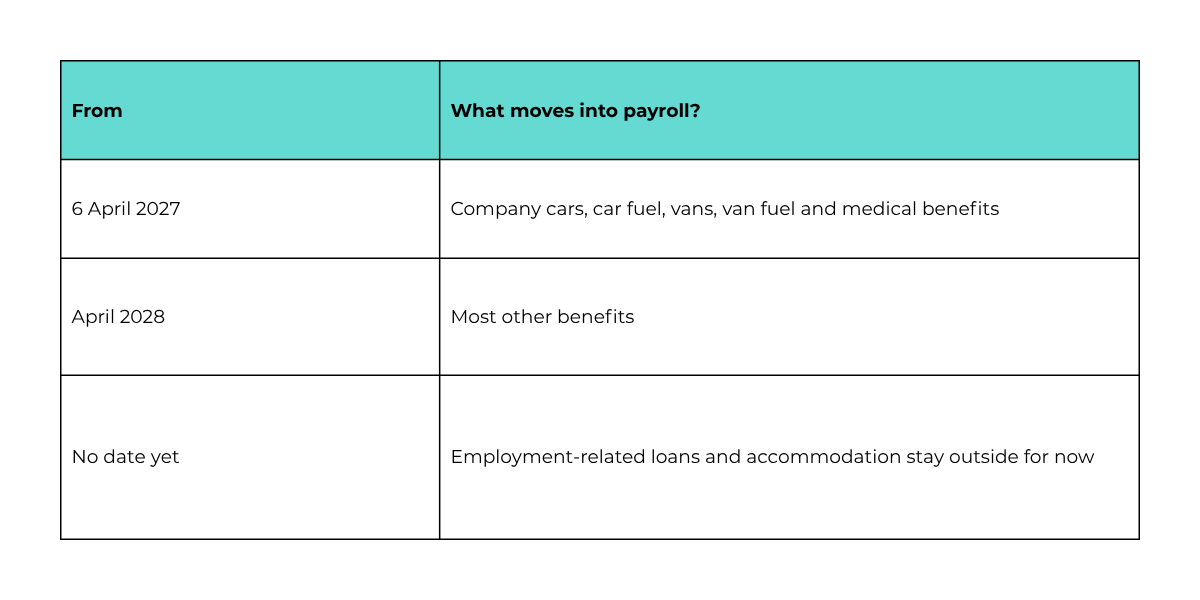
If anyone in your business has a company car or private medical cover, there will be two changes from April 2027. The benefit value shows on their payslip each month, and HMRC adjusts the tax code to take it out.
There’s also a cash flow point for July 2027. Your company pays Class 1A on 2026/27 benefits through the P11D(b) as usual, while also paying Class 1A on 2027/28 benefits through payroll. Plan for both payments landing around the same time.
What happens if a P11D is late or wrong?
You can correct a P11D or P11D(b) using HMRC’s online amendment forms. A late P11D(b) carries a penalty of £100 per 50 employees for each month or part month it’s late, and HMRC charges interest on late Class 1A. Keeping a simple record of benefits through the year makes July much easier.
Your next step
Make a list of any benefits you or your team have had since 6 April 2026 and check whether your payroll is set up for April 2027. We prepare and file P11Ds as part of your year-end, so get in touch if you’d like us to look at yours.